Class Project
Conversational UX Design
Client
N/A
Timeline
3 month research and design sprint
My Role
UX Researcher and Designer
Tools
Voiceflow, Miro, Figma
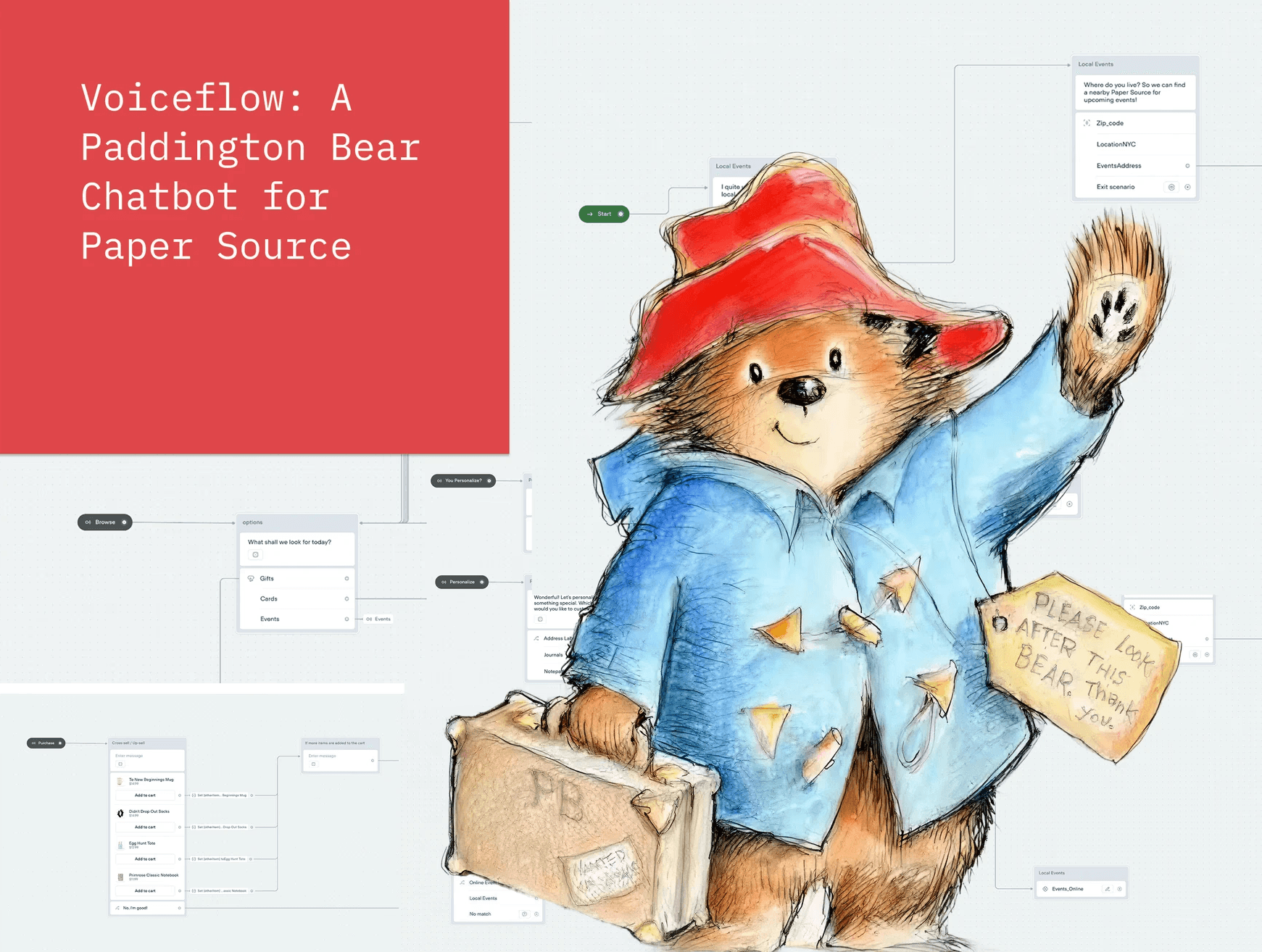
Paddington Bear Paper Source
Paddington Bear, A Papersource agent created to assist user needs.
Paper Source is a stationery and gift retailer with a service journey customers already know how to move through: browsing products, customizing cards, finding local events, checking out. The website works. This project asked a simple question. If Paper Source were to add a conversational agent, who should it sound like? We chose Paddington Bear. Polite, patient, optimistic, the kind of character whose voice fits a stationery brand built on warmth and craft. Over a three month sprint, my team built a working voice and chat agent in Voiceflow, mapping Paper Source's existing customer journey to a set of intents and writing Paddington's responses across each one. I led the character research and owned the Events intent end to end, from utterances to the full dialogue flow. What follows is how we got there. The personality work that anchored every response, the structure underneath the conversation, and an honest reflection on what I'd do differently if I built him again.
Agent Characteristics
The Core Personality of Paddington Bear
These are the 3 core personalities we emulated in our VUI Chatbot from the original Paddington Bear. Core personalities refer to the consistent tone our Chatbot represents based on character research on Paddington Bear.
Polite & Well-Mannered
He always addresses others respectfully.
Kind & Optimistic
He maintains a positive outlook and tries to help everyone, even when misunderstood or facing adversity. For our specific voice agent he does this by always being kind to our users.
Thoughtful
He always thinks about other people's feelings, and tries to do the right thing, even when things go a bit wrong.
Task Flow to Intents
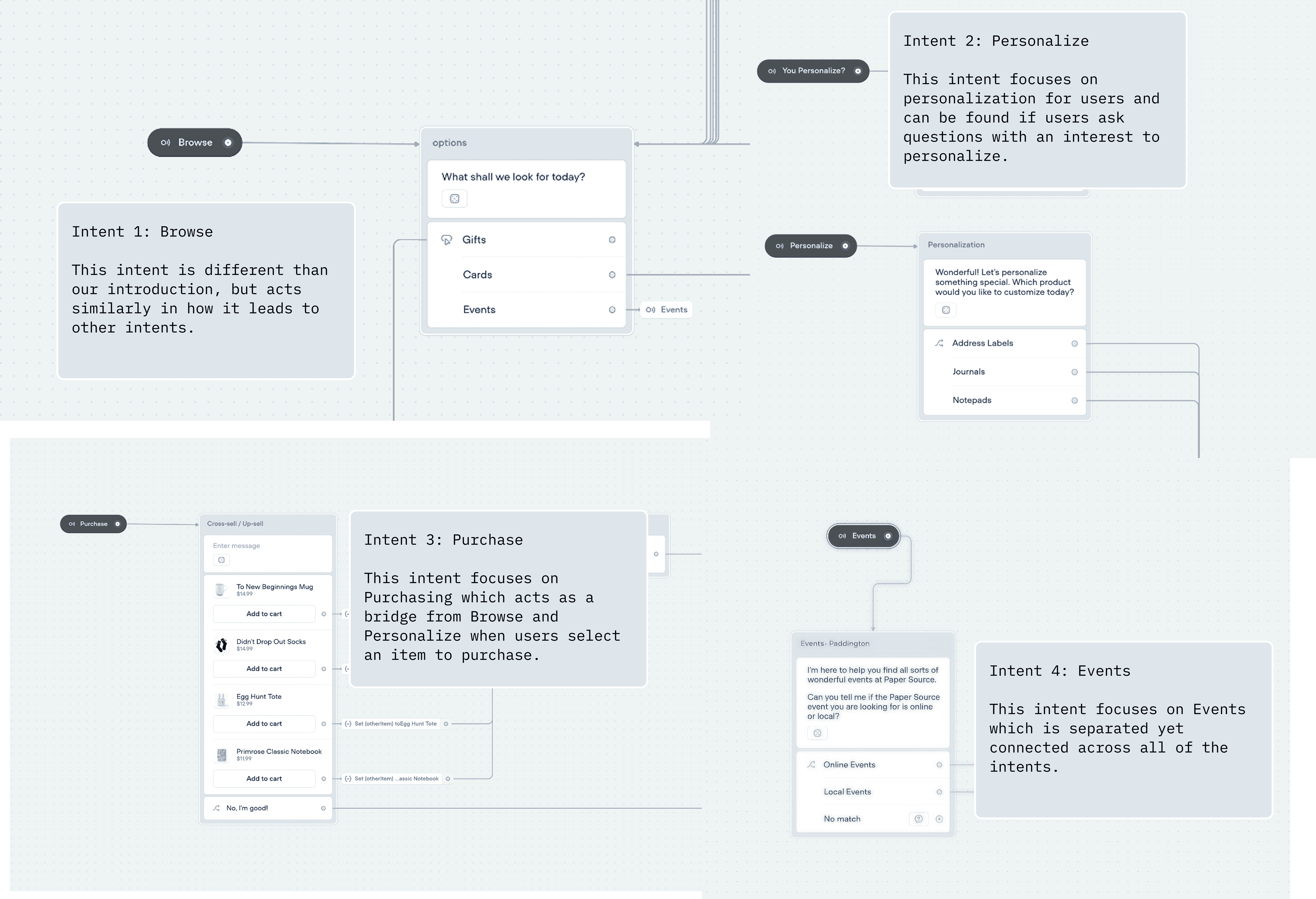
When we started diving into Paper Source's existing service, we noticed the website already had these clear, natural pathways customers were moving through. So our job wasn't to redesign anything, it was really just to understand those paths and figure out where a conversational agent could actually be useful. We started in the background by tracing the existing task flow. Picture it like watching how someone moves through a real stationery shop. Where do they slow down? What pulls them in? Where do they get a little stuck?
We followed those moments all the way through, from landing on the homepage to checking out, customizing products, and exploring events. He's not replacing the journey, he's just sitting above it, ready to jump in when someone could use a hand. The task flow is the map. The intents are the moments where a kind, steady voice makes everything feel a bit easier. It means the service still works the way Paper Source already works, but now there's this warm, personality-driven layer sitting on top of it. And to me that especially matters, the agent's personality, that structure is the whole foundation of what makes a good chatbot. It's what lets Paddington stay consistently Paddington (polite, gentle, optimistic) no matter which intent a user lands in, and that consistency is what makes the whole thing feel like one cohesive experience.
Intents to Utterances
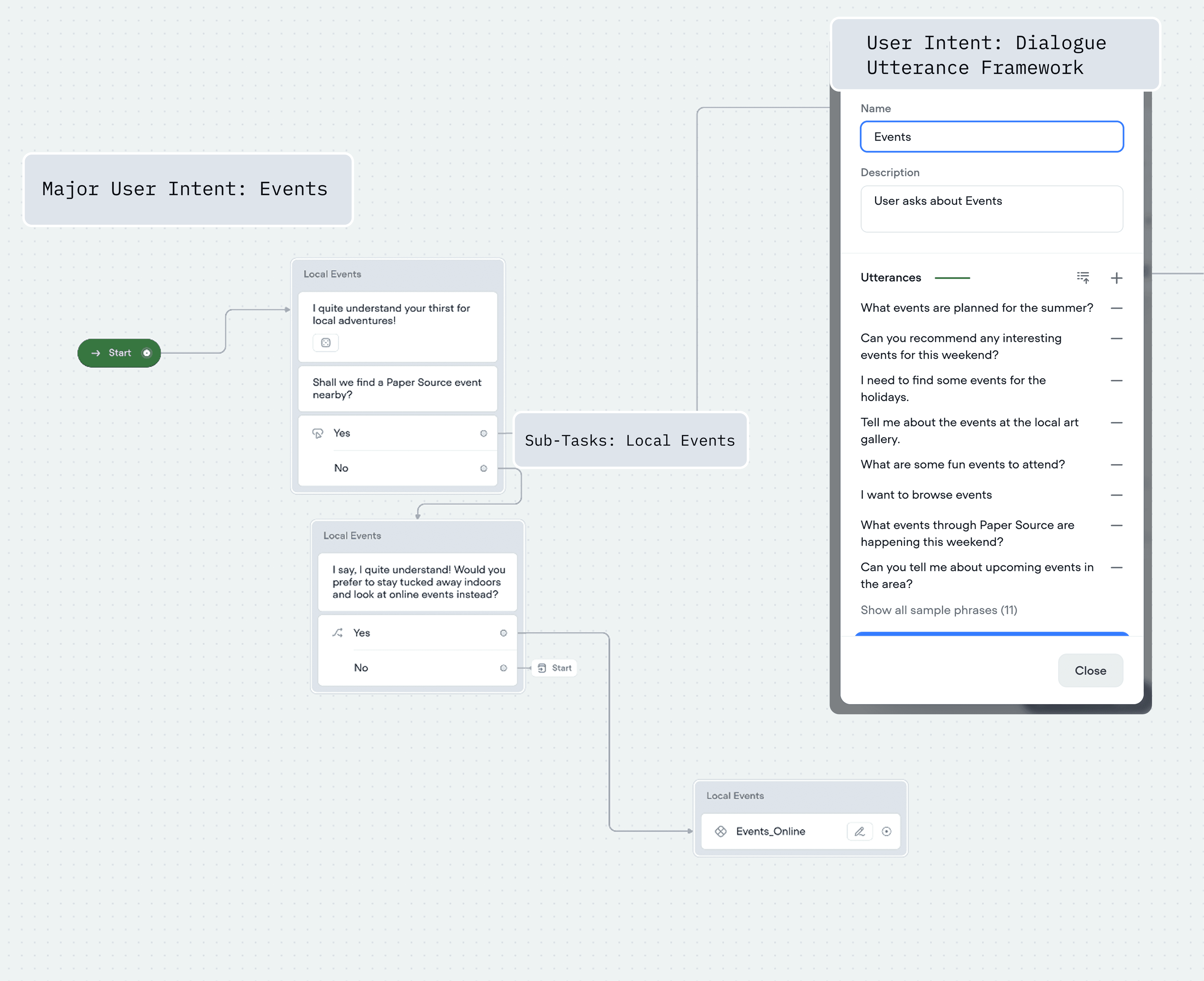
Now let's zoom in a bit further. Within each intent, there's this thing called utterances, and they're basically the triggers that activate the intent. They can be questions, statements, or just casual phrases, however someone might naturally bring something up. Think of them as the little doorways users walk through to start a conversation with Paddington.
For this part, I focused on the intent I built out: Events. Before writing any utterances though, I needed to really understand who Paddington is. Because even though utterances come from the user, the responses are coming from our Paper Source Paddington, and the two have to feel connected. You can't write good triggers without first knowing the voice they're triggering. So I did some pretty extensive research on his personality. I went through the original book material, the movies, and specific video scenes, paying attention to how he speaks, how he reacts to people, how he handles confusion or excitement.
I wanted to get a real sense of his rhythm before putting any words on the page. The logic here is pretty simple. If I understand how our chatbot is going to think and respond, I can write much better utterances on the user side. It's kind of like writing dialogue for a story, you can't really write one character's lines until you know how the other one is going to answer. Locking in Paddington's personality first gave me a clearer sense of the kinds of questions and phrases users would naturally bring to him, especially around something as warm and community-driven as events.
Building a VUI

To understand this better, Let's take a step back and break down what Voiceflow actually is and what it does. Voiceflow is the prototyping tool we used to build out the conversational flows, and it works through a system of connected blocks that map out how a dialogue moves from one moment to the next. Each block represents a piece of the conversation, whether that's something Paddington says, a question he asks, or a response from the user. Walking through the Local Events sub-intent as an example, here's how it comes together. It starts with an introduction block, where Paddington gently introduces the user to this sub-intent of Events, specifically Local Events. From there, the flow moves into a dialogue block paired with a user response block. This is where utterances come back into play. The user response is tied to specific utterances like "yes" and "no," which tell the system how to branch the conversation next. But it's not just a simple yes or no setup. The flow also includes connector blocks that can route users into different intents or sub-intents entirely.
So if someone starts in Local Events but actually wants to explore Online Events, the system can pivot them over without breaking the conversation. And when Paddington asks something more specific, like where the user is located, we use a capture block. This pulls in details like zip codes, locations, or addresses, each with their own set of utterances attached so the system can recognize different ways a user might phrase the same answer. Someone might type their zip code directly, say "I live in Brooklyn," or just paste an address, and the flow needs to handle all of those naturally. The whole point of annotating the VUI this way is to make it clear how each piece fits together. The flow in the background is the structure, and the annotations on top help break down what each block is doing, what utterances are tied to it, and how the conversation can move in different directions depending on the user's response.
VUI to Dialogue
Up close and personal, here is an example of our VUI agent in action with a user as they flow throught the intents.
VUI to Dialogue
Now if we zoom out within the framework. We can see how the whole VUI interaction works altogether.
What Mattered
Anyone can build a VUI. The tools are accessible, the frameworks are teachable, and the technical side is something you can learn with enough time. The harder part is building a personality that actually fits the brand and getting it to respond consistently in a way that feels true to that personality. I've always been interested in people and how personalities work. The way someone speaks, what they care about, how they react under pressure. That carries into the characters I create, and it carried into this project too.
To me, a well-built chatbot isn't just a tool. It's a character, and characters need depth to feel real.
I've been building characters in my writing for years, and that's the lens I brought to this project.
This project didn't go the way I wanted on the personality side. My group didn't prioritize it the same way I did, and Paddington didn't get the development I think he needed. The technical work was solid. The character work was thinner than it should have been.
If I did this again, I'd spend far more time on Paddington himself. A wider range of responses. A clear map of how his tone shifts across situations. More care around the breadth of his personality and how he would respond to the frustration, confusion, silence from the user.
You can't capture a whole person in a voice bot, but you can find the core. The few traits that make someone recognizable. For Paddington, He cares about helping people. He's patient, polite, and assumes the best in others. Once you have a through-line like that, every response has something to anchor to yet as a writer I have an itch to expand beyond the surface.
Depth can be risky in a VUI context. But depth doesn't just mean expanding what the bot will do. It lives in tone, word choice, and how the bot acknowledges the person on the other end.
I also wanted small human textures in Paddington. A little clumsiness in how he phrases things, the occasional self-correction. Not bugs, not detours from the task, just the small imperfections that make a voice feel like a voice the user could trust and connect with more. That's the part of character work people overlook. It's what separates a chatbot that feels like a tool from one that feels real.
Paddington cares about helping the user. That was the core, and every response in the flow had something to anchor to because of it yet some aspects of his personality was missing. I didn't get to build him out as fully as I wanted, but the foundation is there, and it's the part of the project I value.